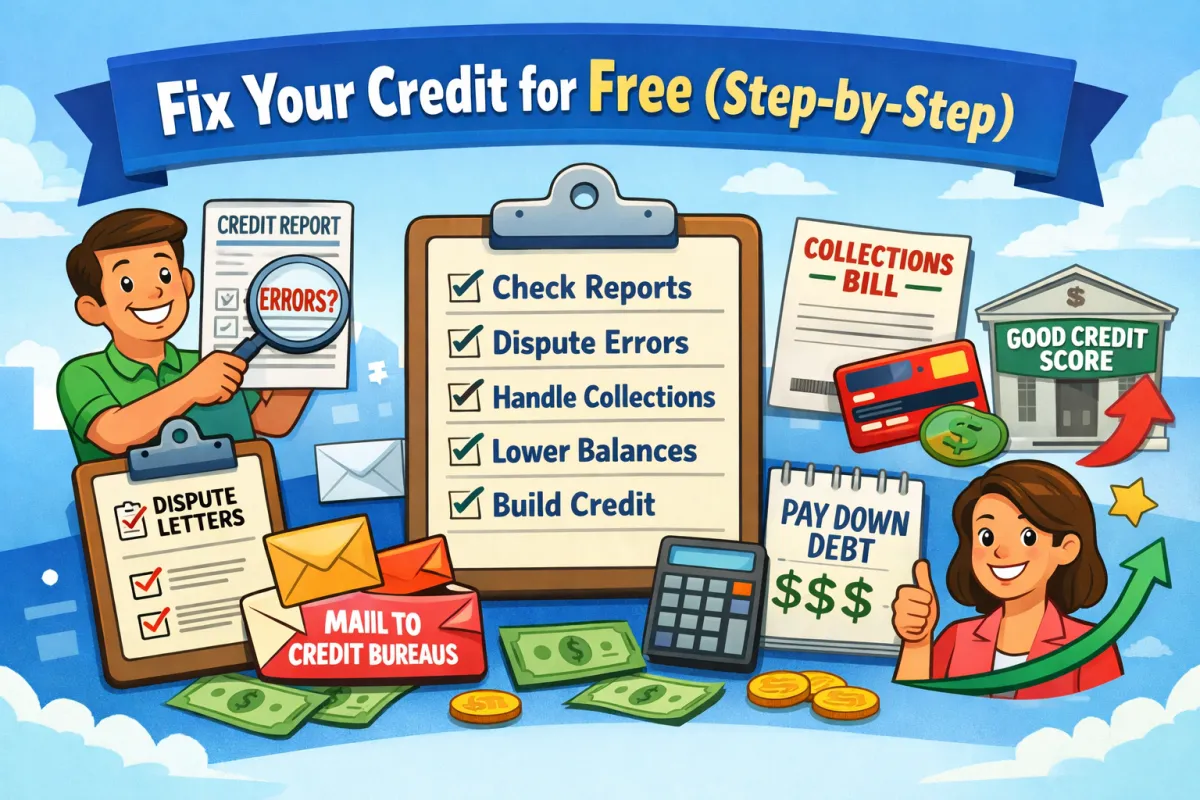
How to Fix Your Credit for Free (Step-by-Step)
How to Fix Your Credit for Free (Step-by-Step)
Important note before you start: You can fix your credit for free. But it usually takes longer than hiring a professional, because you’ll be doing everything yourself—tracking details, writing letters, mailing documents, following up, and staying consistent. If you stay organized and patient, this works.
SECTION 1: Know What “Fixing Credit” Actually Means
Fixing credit is mostly about doing these 4 things:
1) Making every payment on time (this is the biggest factor long-term)
2) Keeping credit card balances low (utilization)
3) Removing or correcting errors on your reports (disputes)
4) Handling collections the right way (validation, settlements, pay-for-delete when possible)
You’re not “hacking” the system. You’re cleaning up inaccurate information and building strong payment history.
SECTION 2: Pull Your Credit Reports (FREE)
Step 1: Get your official reports
Go to AnnualCreditReport.com (this is the official site).
Download your reports from all three bureaus:
• Equifax
• Experian
• TransUnion
Save the PDF files. Print them if you can (printing helps you mark them up).
Step 2: Get your scores (optional)
Your official reports don’t always include your real lending scores. That’s fine. You can still repair your credit using the reports.
If you want monitoring, many banks offer free FICO/Vantage updates, but it’s not required.
SECTION 3: Set Up Your “Credit Repair Folder” (So You Don’t Get Lost)
Create a simple system:
Folder 1: Credit Reports (Equifax, Experian, TransUnion)
Folder 2: Disputes Sent (copies of your letters)
Folder 3: Proof (ID, proof of address, supporting docs)
Folder 4: Responses (bureau letters + results)
Folder 5: Certified Mail Receipts (important)
You’re going to send disputes. Bureaus respond with results. If you don’t track it, you’ll repeat steps and waste months.
SECTION 4: Read Your Reports Like a Detective
Step 1: Highlight every negative item
Look for:
• Late payments
• Collections
• Charge-offs
• Repos
• Foreclosures
• Bankruptcies
• Closed accounts with balances
• High credit card balances
• Incorrect personal info
• Accounts you don’t recognize
Step 2: Check for errors (these are dispute targets)
Common errors that can be disputed:
• Wrong balance
• Wrong payment status (shows late but you paid)
• Wrong dates (date opened, first delinquency, last payment)
• Same debt listed twice
• Collection showing after it should be removed
• Account not yours (mixed file / identity issue)
• Incorrect limit (can inflate utilization)
• Incorrect “authorized user” accounts
SECTION 5: Fix Your Personal Info First (Fast Wins)
Bureaus sometimes attach accounts to you because of personal info matches.
Dispute these if wrong:
• Name variations you never use
• Wrong addresses
• Wrong employers
• Wrong phone numbers
Why this matters: removing incorrect personal info can stop “mixed file” issues and can help disconnect accounts that aren’t yours.
SECTION 6: Build Your Dispute Plan (Don’t Dispute Everything at Once)
Best practice approach
Dispute in rounds.
Round 1: clear factual errors + accounts not yours + wrong personal info
Round 2: inaccurate late payments, wrong balances, wrong dates
Round 3: collections (validation + bureau dispute)
Round 4+: follow-up disputes, reinvestigation requests, escalation
What NOT to do
Don’t dispute 30 items at one time unless it’s identity theft.
That can slow responses and sometimes leads to “frivolous” dispute rejections.
Start with 3–6 items per bureau per round.
SECTION 7: Gather Your Proof (This Helps You Win Disputes)
Before you send any dispute, prepare:
• Copy of your driver’s license or state ID
• Copy of a utility bill or bank statement (proof of address)
• Any supporting documents (payment receipts, statements, letters)
Always include ID + proof of address when mailing disputes. It reduces delays.
SECTION 8: Write Your Dispute Letters (Simple and Clear Wins)
Your dispute letter should be short and specific.
What to include
• Your full name and DOB
• Your current address
• The report confirmation number (if shown)
• The account name + account number (partial is fine)
• Exactly what is wrong
• Exactly what you want corrected or removed
• List of documents included
Simple dispute wording example
“I am disputing the accuracy of the following account. The balance and payment status are incorrect. Please investigate and either correct the information or delete the account from my credit report.”
You do not need fancy legal language. You need clarity.
SECTION 9: Where To Mail Your Disputes (Bureau Addresses)
Send disputes to each bureau by mail for the best paper trail.
Equifax
Equifax Information Services LLC
P.O. Box 740256
Atlanta, GA 30374-0256
Experian
Experian
P.O. Box 4500
Allen, TX 75013
TransUnion
TransUnion Consumer Solutions
P.O. Box 2000
Chester, PA 19016-2000
Recommended mailing method
Send letters Certified Mail with Return Receipt (USPS).
This proves they received it and helps if they “lose” your dispute.
SECTION 10: Know the Timeline (So You Don’t Panic)
In many cases, bureaus have about 30 days to investigate after they receive your dispute (timing can vary depending on how you submit and what you send).
You’ll get a results letter that says one of these:
• Deleted (best result)
• Updated (good result)
• Verified (they claim it’s accurate)
• No change (same as verified)
• Frivolous / irrelevant (they rejected it)
Keep every results letter.
SECTION 11: Handle Collections the Right Way (Do This Carefully)
Collections are a big score killer, but you have options.
Step 1: Request debt validation (especially if it’s new)
If a collection is recent or you’re not sure it’s accurate, you can request validation from the collection agency.
You’re basically saying:
“Prove this debt is mine, prove the amount, and prove you have the right to collect.”
If they can’t validate properly, they should stop reporting.
Step 2: Negotiate when needed
If the debt is valid and you’re ready to handle it:
Option A: Pay for delete (best)
You offer payment if they agree to delete the collection from your reports.
Option B: Settlement (good)
You negotiate a lower amount and pay it. This can still help, but deletion is stronger if you can get it.
Always get agreements in writing.
SECTION 12: Fix Your Utilization (This Can Boost Scores Fast)
Utilization means how much of your credit card limits you’re using.
Targets
• Under 30% is decent
• Under 10% is strong
• Under 5% is best for scoring
Fast strategy
Pay credit cards down before the statement closes (not just before the due date).
The balance that reports is usually the statement balance.
SECTION 13: Add Positive Credit (If You Don’t Have Much Credit History)
If your report is thin or damaged, adding good accounts helps.
Options
• Secured credit card (deposit-based, easier approval)
• Credit builder loan (small loan designed to build history)
• Authorized user (only if the primary card is perfect: low balance, never late)
Avoid random new accounts if you’re about to apply for a mortgage soon. New inquiries can temporarily drop scores.
SECTION 14: Do Dispute Rounds Until You’re Clean
This is the part people quit on.
Here’s the simple cycle:
1) Dispute a small batch
2) Track when it was delivered
3) Wait for results
4) If deleted—great
5) If verified—dispute again with better detail and proof
6) Move to the next round
Credit repair is boring. The people who win are the ones who stay consistent.
SECTION 15: Common Mistakes That Waste Months
• Disputing too many items at once
• Not sending proof of identity/address
• Not keeping copies of letters
• Not using certified mail
• Disputing items that are accurate without a strategy
• Ignoring utilization and payment history while disputing
Disputes help, but your score won’t truly rise if you keep maxing cards or paying late.
Final Encouragement
If you follow this step-by-step process, you can absolutely improve your credit for free. It takes time, patience, and organization—but it works. Start with your reports, dispute the clear errors first, handle collections smart, and build positive history at the same time.